Wednesday, December 25, 2013


Thursday, August 2, 2012
A successful batch of golden albinos .
Recently , acquired a pair of golden albino from Felix. I proceeded to cross the pair with my own GA pair. After a few unsuccessful tries, both pairs are now carrying around 50 to 80 fries respectively. Not only have I managed to out cross my lineage, now the pair seemed to be able to carry their own fries without the need for any foster parents. As you may know albino discus are usually poor parents , meaning the fires usually end up not attaching to the parents and die away after a few days. However, from the pictures, you can see that they are excellent parents like most discus. The first two days are crucial to determine if the pair is able to carry the brood. Clean water and lowering the water level will greatly help them in this. This pairing is helping me reduce my stock of foster parents. Now, I hope the offspring will be worth their weight in gold!

Wednesday, August 1, 2012


Wednesday, March 21, 2012
Red calico


Friday, August 26, 2011
Discus for SALE
From time to time, I have discus that are put up for sale. If you are interested in purchasing my discus, you can email me at villa292@hotmail.com or you can contact me at my mobile number : 97826284. Best is if you could leave me an sms.
Currently, I have a few batches of my Reds, Blue Paradise and Red Calico discus. Also have a pair of Albino Blue diamond as of 27/08/2011.
Currently, I have a few batches of my Reds, Blue Paradise and Red Calico discus. Also have a pair of Albino Blue diamond as of 27/08/2011.
Thursday, July 7, 2011
A little red suprise!

 The red pair already on the second batch.
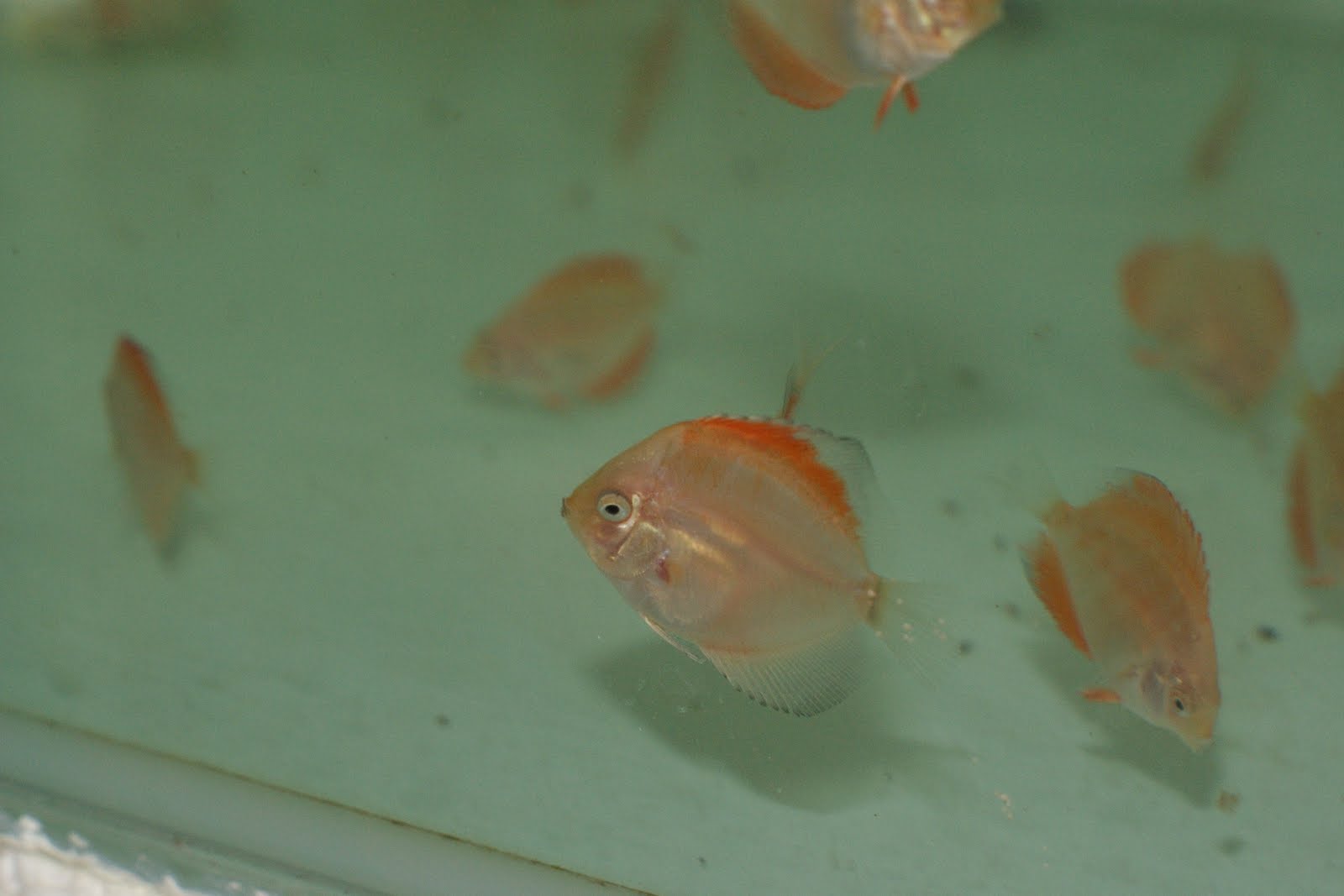 |
 At one inch size, I noticed something other than reds in the batch. In fact ,Felix Low was the first to alert me when he saw the batch. He told me that there were some calico discus in the batch. I didn't think much of it hoping that the fries will just get redder as they grow.

As the fries were growing, it was evident that the Calico discus were there to be seen. This led me to figure out that the genetic make of the reds I had, had ghosts discus genes.


At one and a half inch size, the full red juvenile showing good potential. Wonder how red they can get at 3 inches.

Yet, the little diversion of the calico discus was growing by the day. In fact, the red colouration was getting deeper as they grow. Further, it reminded me of the Singapore Flag. I really wish, one day to produce a discus just like the Singapore Flag with a tremendous amount of luck!.


My Red Calico Discus at 2 inch size.

Hope to update on them when they grow bigger. Do not have the space to house them all and have already been getting a few offers. Hope they can leave up to expectations.

The reds almost reaching 2 inch in size and the colour is getting intense.


The batch is now 3-4 inch in size. I have added a little red color enhancer (astaxanthine) to their food to see their potential. After 3 weeks of color feeding, the discus look great. Though most of them show strong coloring to 3 parts of their body, some pieces exhibit coloring up to forehead and gills. As for the calico's , I feel coloring them is not advisable as their body color turns a little pink thus not giving a good color contrast. 20/09/11


Friday, June 24, 2011
My first venture into Full Reds
 (The red likely colour enhanced with a different colour enhancer)
Red discus has always been a favourite of many hobbyist. Recently, the full reds have become a sight to behold. Also, they have been giving the LSS a run for their money in recent competitions, obviously led by my good friend Ricky Lim(Multiple Grandchampion/Malaysia). His reds are in a different league!
I too took a plunge into breeding reds, late last year. Two pcs were a gift from a friend while another was bought from a local breeder. The following are some pictures of them.


The above pictures were taken when they were about 4 inches. When I took over the reds they were full red but because I don't really colour feed my discus, the redness ceased alot. Nevertheless, I was not worried as I knew the pedigree of the reds I had.
 The female on the right of the picture was of a different linage which I chanced upon. Within weeks, I paired them up and soon they produced a batch. From the pictures, you can see that the red colour has changed yet again because tetra bits were included in their diet.


Friday, May 13, 2011
My spotted collection.


Recently, accquired a LSS collection from my friend. They have good spottings till the gill plates, especially the males. A week after purchase saw a two pairs forming. Hope for the best!
Whitescorpion evolves


From this to this in 6 months.
Some full coloured discus take a longer time to turn full colour. When young, they are often heavily patterened and as they mature, these patterns merge. They need proper care to speed up the process or lack of care may result in the patterns not merging. Sometimes it is good to avoid buying discus that show strong colouration at 2 inch size.
Saturday, June 5, 2010
Albino Pattern
The Unlikely Siblings all grown up

Would you believe that these beauties are actually the siblings of the Albino Blue series. They are a good representation of striated discus. I only kept 4 pcs of the patterned albinos. a shame considering how they turned out. There were also a few Albino snakeskins that were part of this batch. My friend bought all of them when they were about 3 inches. They too turned out well. In fact I suggested to my friend,Mr Lim, to take part in the National Discus Competition and it proved worthwhile as he bagged the 2nd & 3rd prizes in the Albino Pattern Class.


Would you believe that these beauties are actually the siblings of the Albino Blue series. They are a good representation of striated discus. I only kept 4 pcs of the patterned albinos. a shame considering how they turned out. There were also a few Albino snakeskins that were part of this batch. My friend bought all of them when they were about 3 inches. They too turned out well. In fact I suggested to my friend,Mr Lim, to take part in the National Discus Competition and it proved worthwhile as he bagged the 2nd & 3rd prizes in the Albino Pattern Class.


Friday, May 21, 2010
Back In Business
 r
r
From the earlier post you may have guessed why I have not blogged for a long time on Discus. what has happened to my collection? Frankly it has shrunk to a manageable size of 10 tanks. Beside concentrating on keeping songbirds, the current water source is becoming even more challenging then keeping discus itself. The chlorine and chloramine levels have increased. the trace elements are lesser. the PH has gone up to 7.8.
In the past, say 5 years back, I did not have to you use anti-chlorine to condition the water after water change. But now, the discus parish within 3 hours if I forget to add the water conditioner which I have guilt fully done on several occasions and lost quite a sizable number of young and adult discus. It really gives you an heartache when you see the floating bodies of dead discus. In the past, discus can grow to 2 inch size in 2 months but now takes 3 months. Everything else being constant, you have to put your finger on the 'New Water'. Although, it has become a little more tough keeping discus here, I am sure our fellow hobbyist all around the world would still envy our good fortunes.
Another of my disappointment was the breeding or non of it. My pairs were breeding occasionally but most of the time the eggs turned white or the pair ate the eggs up. Further, my F1 Blue Albinos were not breeding though they had reached breeding age. Slowly I started selling of my collection keeping the minimum number of adults to kick start my breeding once I solve the teething problems
.

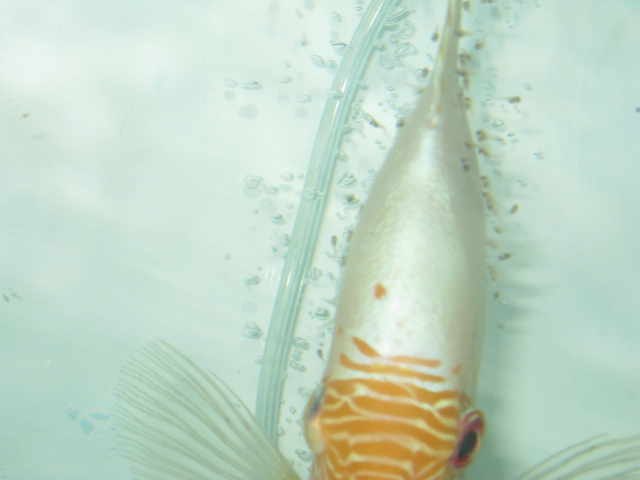

After going back to basics, adding (MB)methylene Blue, I managed to get out two small batches of fries from two pairs. One being the white scorpion x blue pigeon and the other the F1 Blue Paradise. I had stopped using MB for more than 7 years as I opt to keep the breeding tanks clean. But now the MB has helped to prevent all eggs turning white. However, the hatching rate is poor as there is still a large number of eggs that turned white despite adding MB. It can only mean that the males are not up to the mark. I would need to look into the diet so as to improve the hatching percentage but on the other hand , a smaller batch is easier to care .

I hope to get some nice white butterflies from the whitescorpion x blue pigeon crossing. For the blue paradise, hope to see some goldens and off course nicer blue paradise.


Subscribe to:
Posts (Atom)